Off-grid solar is a field where the gap between a specification sheet and reality is wider than in almost any other consumer category. Inverters are rated optimistically, surge figures are quoted as if they were continuous, and a wattage number on a box tells you very little about what the unit will do on a hot afternoon in year three.
Both of these brands come up constantly in the same searches, and both sit well below the premium tier. Here is how to compare them usefully.
The short version
Renogy if you want better documentation, a larger support operation, and an ecosystem of matched components that are known to work together.
SunGold Power if you want more output per dollar on larger inverter-chargers and you are confident enough to specify and troubleshoot a system yourself.
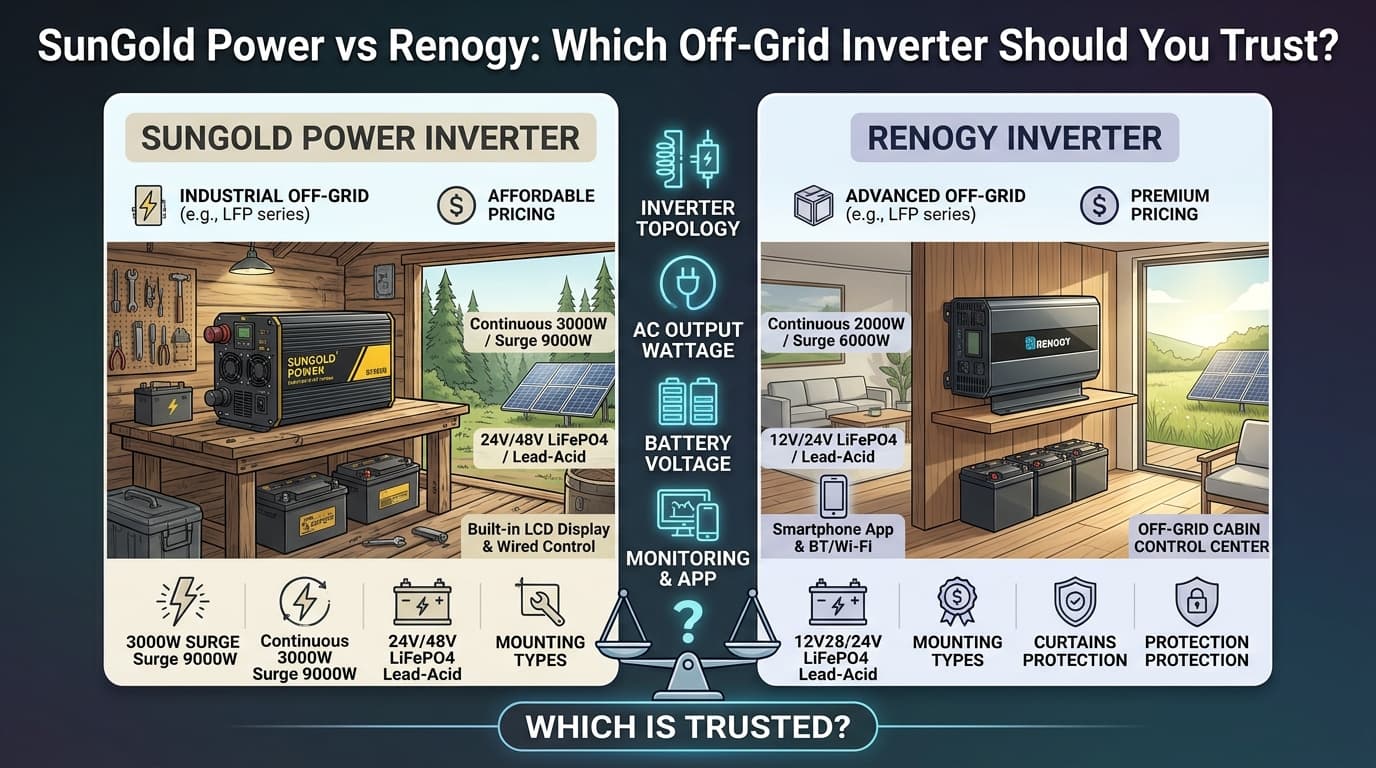
Continuous versus surge — the number that matters
The single most important thing to understand in this category.
Continuous output is what the inverter will sustain indefinitely. Surge is what it handles for a few seconds while a motor starts.
Motors — fridge compressors, pumps, air conditioners, power tools — draw several times their running wattage at startup. A fridge that runs at 150W may pull 800W or more for a moment. If your surge headroom is insufficient the inverter trips, and you find out at the worst possible time.
So: size by continuous rating against your total simultaneous load, and check the surge rating and its duration against your largest motor. A "3000W" inverter from two different brands can behave very differently depending on how honestly each defines those two numbers, and that is precisely where budget brands diverge from premium ones.
Ask for surge figures with a stated duration. "Surge 6000W" means little; "6000W for 20 seconds" is a specification.
Pure sine wave, non-negotiable
Confirm the unit is pure sine wave, not modified sine wave.
Modified sine wave is cheaper and will run simple resistive loads. It causes problems with motors, electronics, medical equipment, some LED lighting and anything with a sensitive power supply — running hot, buzzing, or failing early.
Both brands sell pure sine wave units. Check the specific model rather than assuming.
Documentation, which is where Renogy is genuinely stronger
For anyone building a system rather than buying an appliance, documentation is a feature.
Renogy's advantage is a mature ecosystem: panels, charge controllers, batteries and inverters designed to work together, with wiring diagrams, sizing guidance and a large body of published material and community discussion. If you are learning as you go, this materially reduces the chance of an expensive mistake.
SunGold Power's documentation is thinner. Discussion of its units in DIY solar communities tends to be positive on hardware value and less so on manuals and support responsiveness. For someone who already knows how to size a system and read a wiring diagram, that is an acceptable trade. For a first build, it is not.
Be honest about which you are.
Charge controller type
If you are buying a kit or an all-in-one, check whether the integrated solar charge controller is MPPT or PWM.
MPPT extracts significantly more energy from the same panels, particularly in cold or low-light conditions, and in partial shade. PWM is cheaper and loses you real harvest.
For anything beyond a very small system, MPPT is worth the difference. Both brands offer both — check the model.
Battery compatibility
Modern systems are mostly LiFePO4, and the inverter-charger must have an appropriate lithium charging profile, ideally configurable, and preferably able to communicate with the battery's BMS.
Charging lithium with a lead-acid profile shortens battery life and in the worst case is a safety issue. Confirm supported chemistries and whether charge voltages are user-settable before buying either brand.
Support, and why it matters more here than elsewhere
This is high-voltage equipment connected to your home or vehicle. If it fails, you want a path to a replacement.
Renogy is the larger operation with wider distribution and more established support.
For SunGold Power, check warranty length, where service is handled for your country, and whether parts are available separately. Reviews in both directions exist for most brands in this tier; what you are looking for is a process that exists at all.
Installation and certification
This is important and frequently skipped.
Grid-tied or home-connected installations are regulated in most countries and often require certified equipment and a licensed installer. Equipment that is fine for an off-grid cabin or a van may not be approved for connection to a dwelling's wiring.
Before buying either brand for a house, check what certification your jurisdiction requires — in the US this typically means UL listing and relevant code compliance, with equivalents elsewhere. Uncertified equipment can invalidate insurance, which is a far larger exposure than the price difference between these two brands.
For vans, boats, cabins and shed systems, this is less constrained, and that is where these brands are most commonly used.
So which?
Renogy if: this is your first system, you want matched components and good documentation, or you need the support of a larger operation.
SunGold Power if: you are specifying a larger inverter-charger, you know how to size and wire it, and output per dollar is the priority.
Neither, from a listing alone, if: you are connecting to a house. Check certification requirements first.
Before you buy
Add up your continuous load and your largest motor's surge. Confirm pure sine wave. Check the charge controller is MPPT for anything but the smallest system. Verify the lithium charging profile. Check certification requirements for your installation type. Confirm warranty terms and service location.
Then check for an offer. Solar equipment discounts seasonally and the amounts on inverters are significant. Current verified SunGold Power codes are on Discountsmaniac.
Need portable backup rather than a fixed install? See Dabbsson vs EcoFlow: Which Portable Power Station Suits Your Outages?.
Anita Hills writes about consumer products and the practical business of buying them well. She covers home fitness, pool and garden equipment, desk hardware, automotive parts and personal care, with a focus on what a product is actually like to live with rather than what its spec sheet claims.
All articles by Anita