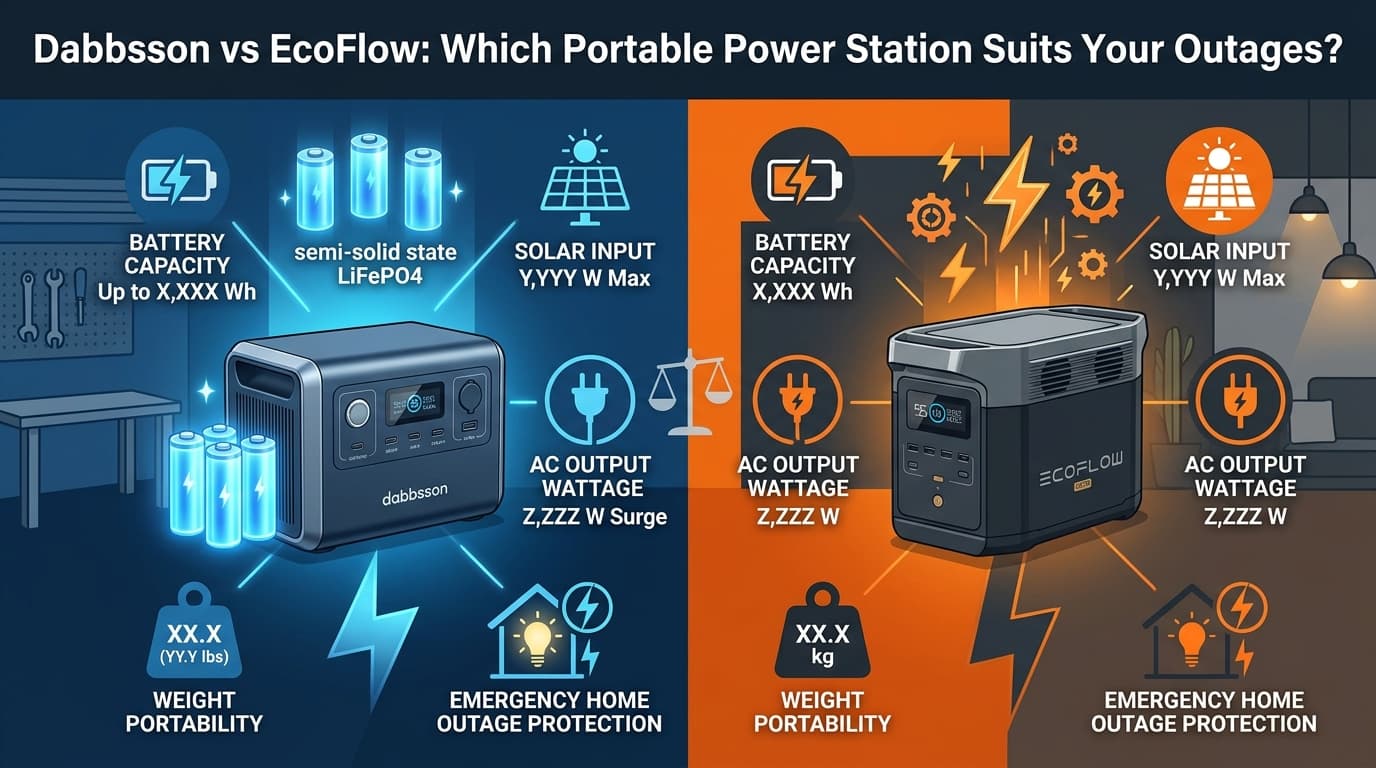
Portable power stations stopped being a camping novelty somewhere around the point that grid outages stopped being rare. The question most people are actually asking is not "which is best" but "how long do I need to run a fridge, and what does that cost."
Those are different questions, and they point at different brands.
The short version
EcoFlow if you want the fastest recharge in the category, the widest accessory ecosystem, and a brand with the deepest support network.
Dabbsson if you want more usable capacity per dollar and the ability to bolt on extra batteries until the thing covers a genuinely long outage.
Start with how long, not how big
Everything follows from this.
Work out your actual load. A fridge cycles — it draws a few hundred watts when the compressor runs and almost nothing between. Over a day a typical domestic fridge uses somewhere around 1 to 2 kWh. Add phones and a laptop and you are still under 2 kWh. Add anything that makes heat — a kettle, a space heater, a hair dryer — and you blow through a power station in minutes, because heat is where the watts go.
Now:
A few hours of fridge and devices: around 1,000Wh is plenty. Both brands sell here.
A full day or more: you want 2,000Wh and up, and you should be thinking about expandability.
Several days: you want a base unit plus extra battery modules, and this is where Dabbsson's structure gets interesting.
Capacity and expandability
Dabbsson's pitch is capacity per dollar with a modular path upward. The DBS2300 sits at roughly 2,330Wh in the base unit, and the range is designed around adding external battery modules — stacked configurations reach into the many-kilowatt-hour range. Reviewers covering the DBS2300 have generally landed on the same conclusion: a lot of stored energy for the money, with the expansion path as the real argument.
EcoFlow also offers expandable units across its Delta range, and its ecosystem is broader — smart panels, alternator chargers, solar products that talk to each other.
The difference in practice: if your plan is one unit that does a weekend, either works. If your plan is a system that grows to cover a multi-day outage, compare the cost per added kilowatt-hour, not the headline price. That number is where the brands genuinely diverge, and it is the number most reviews skip.
Battery chemistry
Both brands use LiFePO4 (lithium iron phosphate) across their current ranges, and you should not buy anything in this category that does not.
Why it matters: LiFePO4 handles thousands of charge cycles before meaningful degradation, where older lithium-ion chemistries manage a fraction of that. For a unit that sits charged for months and gets cycled occasionally, it is the difference between a device that lasts a decade and one that quietly dies in three years.
Check the stated cycle count and the percentage of capacity retained at that count. "3,000 cycles to 80%" is a real specification. A brand that does not publish one is telling you something.
Charging speed
This is EcoFlow's clearest advantage and it is a genuine one.
EcoFlow built its reputation on very fast AC recharging — large units going from empty to most of full in around an hour. If your outages are short and frequent, or if you need to top up quickly in a window between problems, that is worth real money.
Dabbsson charges competently but this is not where it competes.
Ask yourself honestly whether you need it. For a unit that sits plugged in as backup and tops itself up at leisure, charging speed is close to irrelevant. For someone running off-grid and recharging from a generator for an hour a day, it is the whole specification.
Solar input
Both accept solar. Check three numbers rather than the headline wattage:
Maximum solar input in watts — how fast it can harvest
Voltage range — which panels you can actually connect
Whether it charges from solar and AC simultaneously
Solar is where the marketing gets loosest across the whole category. A unit rated for a high solar input still only harvests what your panels, your latitude and your cloud cover deliver, which in practice is often half of the panel rating.
Support, and why it matters here
EcoFlow is the larger company with the wider distribution and the more established support operation. For a device holding several kilowatt-hours of lithium, that is not a trivial consideration — if something goes wrong you want a warranty process that exists.
Dabbsson is smaller. Check the warranty length and, more importantly, where service is actually handled for your country before buying. This is the question to ask for any brand in this category that is not one of the big three.
So which?
Short, frequent outages; you want to recharge fast between them: EcoFlow.
Long outages or off-grid use; you want maximum stored energy per dollar and a path to expand: Dabbsson, with the expansion cost calculated before you commit to the base unit.
You already own accessories from one ecosystem: stay in it. Cross-brand expansion batteries are not a thing.
You want to run heating or cooking off it: neither, and no power station in this class. Heat loads need a generator or a far larger system.
Before you order
Add up your actual loads in watt-hours over the period you need to cover, then add 30%. Check the continuous output rating against your highest-draw appliance, not just capacity — a fridge compressor's startup surge is several times its running draw. Confirm the cycle rating. Check warranty terms and service location. And weigh it, physically — "portable" at this capacity means two-handed and heavy.
Then check for an offer. This category discounts aggressively around seasonal sales, and the swings are large enough to change which model you can afford. Current verified Dabbsson codes are on Discountsmaniac.
Planning a full off-grid setup? See SunGold Power vs Renogy: Which Off-Grid Inverter Should You Trust?.
Anita Hills writes about consumer products and the practical business of buying them well. She covers home fitness, pool and garden equipment, desk hardware, automotive parts and personal care, with a focus on what a product is actually like to live with rather than what its spec sheet claims.
All articles by Anita