Most parents arrive at this comparison the same way. Somebody recommended Lovevery, you looked at the price of a single play kit, and you went looking for whether the wooden toys that cost a third as much are meaningfully worse.
It is a fair question and it has a real answer.
The short version
Lovevery if you want the decision made for you — age-appropriate toys arriving automatically, with the reasoning explained — and the subscription cost is comfortable.
Tiny Land if you are happy choosing toys yourself, you want the same category of wooden, open-ended play for substantially less, and you would rather buy the larger items outright.
What each actually sells
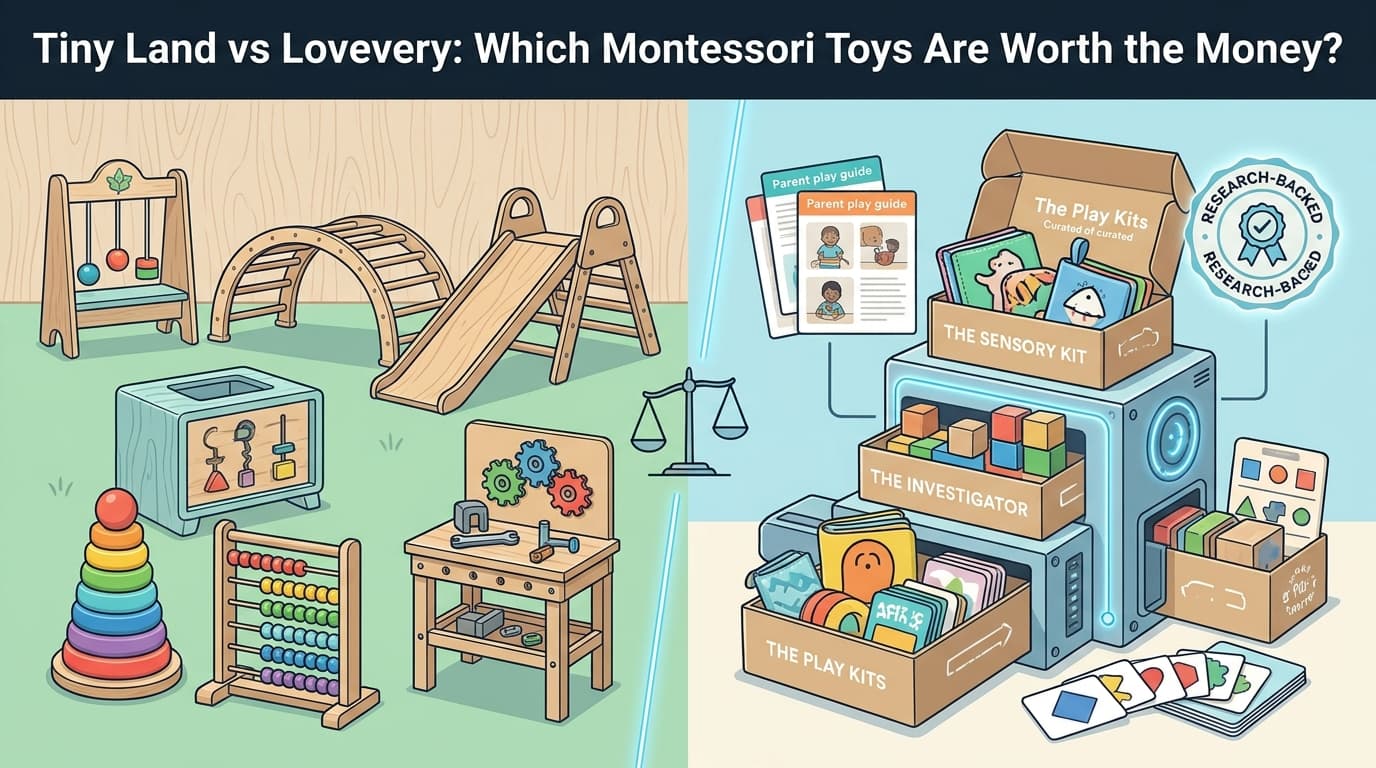
Lovevery sells Play Kits on subscription. A box arrives every few months, matched to your child's developmental stage, containing a small set of toys plus a guide explaining what each one is for and what skill it targets. The toys are well-made, mostly wood and natural materials, with a consistent muted aesthetic.
Tiny Land sells individual wooden toys and sets outright — play kitchens with storage, play food sets, Montessori toy sets grouped by age band from around ten months upward, play tents, and the larger furniture-scale items. You pick what you want, when you want it.
That structural difference drives everything else.
Price
Lovevery kits run to roughly the cost of a decent individual wooden toy each time, arriving several times a year for years. Over a child's first three years the cumulative spend is significant — many hundreds of pounds or dollars.
Tiny Land's individual items and sets sit well below that per item, and you buy only what you want. A wooden play kitchen from Tiny Land costs a fraction of what the equivalent premium-brand item does.
Where the comparison gets honest: you are not comparing like for like on quantity. Lovevery's cost includes curation and the research behind it. Whether that is worth the premium depends entirely on how much you want to think about this.
What the subscription genuinely buys
Three things, and they are real:
You stop researching. For a first-time parent who finds the volume of toy advice exhausting, a box arriving with the right things in it is worth money. This is the main product.
Developmental sequencing. The toys arrive roughly when a child can use them, rather than sitting in a cupboard for eight months. Lovevery's stage matching is genuinely good at this.
The guides. Each kit explains what the toys are for. Some parents find this the most valuable part; others never read them.
What it does not buy is better wood. Both brands make solid wooden toys. The build quality gap is much smaller than the price gap.
What buying outright genuinely buys
You choose for your actual child. Developmental stages are averages. A child obsessed with stacking and indifferent to shape sorting gets a box containing both regardless. Buying outright means buying more of what is working.
Large items at sensible prices. Play kitchens, tents and furniture-scale toys are where Tiny Land's pricing is most noticeable, and they are also the items children use for years rather than months. Subscription boxes do not cover this category well.
No commitment. Children's interests are unpredictable, and household budgets change.
The thing nobody says about Montessori toys
Most of what gets marketed as "Montessori" is wooden and neutral-coloured. Actual Montessori principle is about open-ended materials a child can use independently, with a single clear purpose and no batteries.
By that standard, both brands qualify, and so does a set of wooden blocks from anywhere. The word is doing marketing work in both cases.
What actually determines whether a toy gets played with:
Can the child use it without an adult setting it up?
Does it do one thing well rather than five things badly?
Is it accessible — on a low shelf, not in a toy box?
A cheaper toy that meets those tests beats an expensive one that does not.
Build quality and safety
Both use wood and both state compliance with the relevant toy safety standards for their markets. Check certification for your country specifically — standards differ between regions, and a product listing aimed at one market may cite a standard that is not the one that applies to you.
Practical checks that matter more than brand: sanding quality on edges, whether paint is non-toxic and well-adhered, and small-part sizing for the age of your child. Inspect anything that arrives, from either brand.
So which?
Choose Lovevery if: this is your first child, you find toy research draining, the recurring cost is comfortable, and you value having the decision removed.
Choose Tiny Land if: you want the big items — play kitchen, tent, furniture-scale toys — without premium pricing; you have a second child and already know what gets used; or you would rather spend the difference on something else entirely.
A reasonable middle path: take a Lovevery kit or two during the stage you feel least confident about, and buy the larger wooden items outright. Nobody requires you to pick a team.
Before you buy
Check the age band against your child's actual stage, not their birthday. Look at where the toy will live — accessible storage matters more than the toy. For anything large, measure the space. And check the return policy on big items, which is where the money is.
Then check for an offer. Wooden toys discount meaningfully around seasonal sales, and the larger items are where a code is worth having. Current verified Tiny Land offers are on our sister site, Discountsmaniac's Tiny Land page.
Anita Hills writes about consumer products and the practical business of buying them well. She covers home fitness, pool and garden equipment, desk hardware, automotive parts and personal care, with a focus on what a product is actually like to live with rather than what its spec sheet claims.
All articles by Anita