This is general information, not dental advice. Clear aligners move teeth, and whether any treatment suits you is a clinical decision requiring a dentist or orthodontist who has examined your mouth. See one before starting anything.
The price difference here is not subtle. At-home clear aligner treatment is commonly advertised in the hundreds; in-office Invisalign treatment typically runs into several thousand.
A gap that size always prompts the same suspicion — that somebody is overcharging. That is not really what is happening, and understanding what the money actually buys is the only way to decide sensibly.
What you are comparing
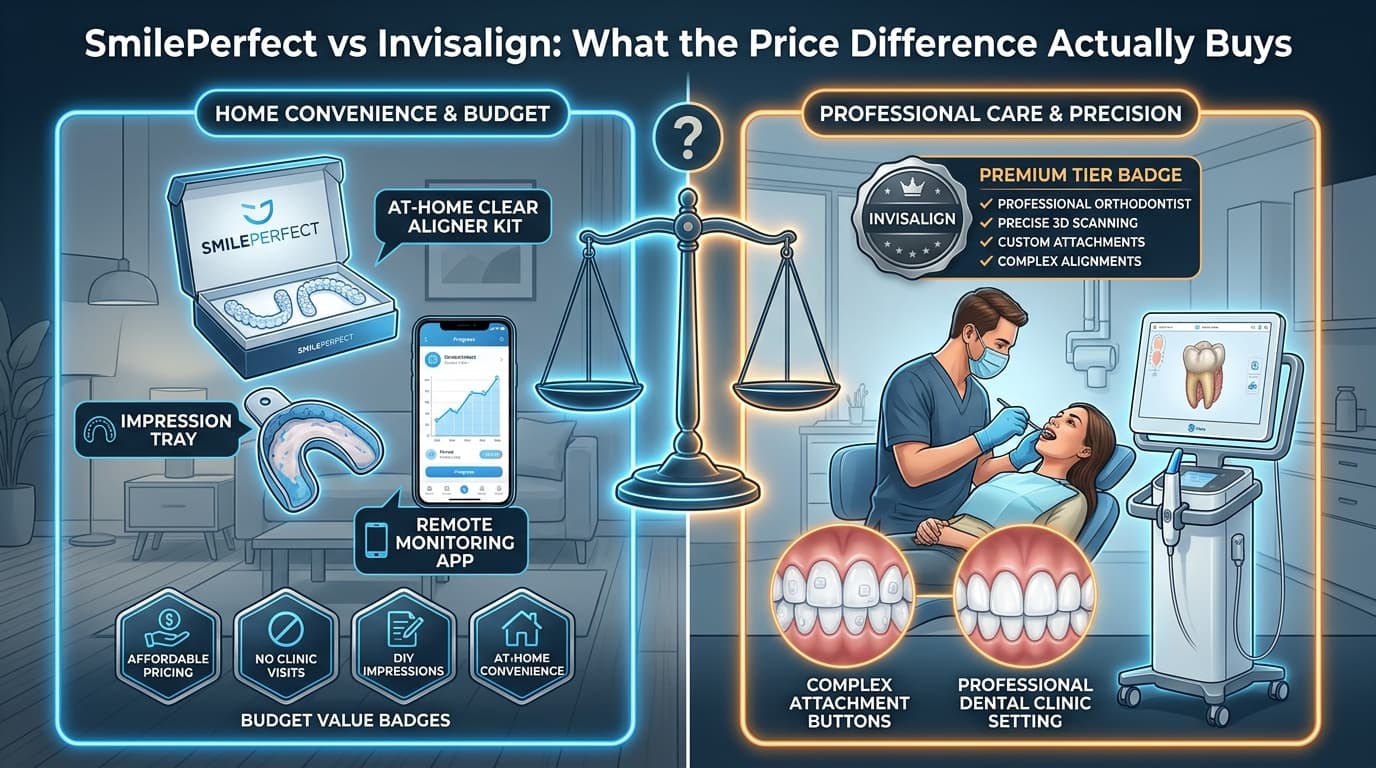
SmilePerfect is a direct-to-consumer clear aligner company. You take impressions at home or have a scan, a treatment plan is produced, aligners are manufactured and shipped, and you progress through them at home with remote oversight. Its published pricing runs from the mid-hundreds for single-arch day-time treatment up to a premium tier above a thousand, with an impression kit charged separately and financing available. It offers both day-time and night-time wear options, and a shorter "fast track" option for minor cases.
Invisalign is a product used by dentists and orthodontists in a clinical practice. A clinician examines you, takes scans, usually bonds small attachments to your teeth, and adjusts the plan over regular appointments. The price is largely the clinician's time, not the plastic.
Where the money goes
Four things, and they are real:
Clinical examination. Someone qualified physically examines your teeth, gums and bite before anything starts. This catches problems — decay, gum disease, root issues, an unsuitable bite — that photographs and impressions can miss. Moving teeth in an unhealthy mouth makes things worse.
Attachments. In-office treatment typically uses small composite bumps bonded to specific teeth, giving the aligners something to grip. These make certain movements possible — rotating a round tooth, moving a root rather than tipping a crown — that are difficult or impossible without them. This is the main reason in-office treatment handles more complex cases.
Intervention when things go wrong. Teeth do not always track as planned. In a practice, this is spotted at an appointment and the plan is revised. At a distance, it is spotted later, if at all.
Refinement. Most in-office treatment includes additional aligners at the end to finish what the initial series did not. Whether at-home providers include this, and at what cost, varies and should be asked.
Where at-home treatment is genuinely appropriate
It is not a worse version of the same thing. It is the right tool for a narrower set of cases.
For mild to moderate crowding, spacing, minor rotations, and relapse after previous orthodontic work, at-home aligners can achieve good results at a fraction of the cost. Reputable providers, SmilePerfect included, have plans reviewed by licensed clinicians and assess candidacy before manufacturing.
If your concern is cosmetic, confined to the front teeth, and you would describe it as "slightly crooked," you are plausibly in range. The assessment decides it, not you.
Where it is not
Significant bite problems — noticeable overbite, underbite or crossbite. Severe crowding. Cases needing extractions. Cases requiring real root movement. Any unresolved decay or gum disease.
If you fall here, the comparison is already resolved and shopping for a provider who will say yes is a bad idea.
Day-time or night-time
SmilePerfect offers both, at different prices, and this deserves thought rather than a default.
Day-time aligners require long daily wear — effectively in your mouth except when eating, drinking anything but water, and brushing. Night-time options require a shorter continuous period while you sleep, and take correspondingly longer overall.
Choose the one you will actually comply with. An abandoned day-time treatment achieves less than a completed night-time one, and compliance is the single largest variable in whether at-home treatment works at all.
The question the last few years taught everyone to ask
The at-home aligner sector has seen companies cease operations, leaving customers partway through treatment with no remaining aligners and no provider. Byte, one of the larger names, is no longer operating in the US, and customers were affected.
That is not an argument against the category. It is an argument for asking, of any provider:
What happens to my treatment if the company stops trading?
Are my aligners manufactured in advance, or made as I progress?
Is my treatment plan recorded somewhere a different clinician could pick it up?
Are refinements included, and what do they cost?
What happens if my teeth do not track as planned?
An in-office provider is not immune to closing either, but your records sit with a licensed practice and are transferable to another, which is a materially different position.
Retainers
Teeth move back. This is not a risk; it is what teeth do.
Retention after treatment is part of the treatment, whichever route you take, and retainers wear out and need replacing periodically for years. Budget for this from the start, and ask what is included. A treatment price that excludes retainers is not the real price.
So which?
Get assessed first. This is not a cost comparison until you know what your case needs. See a dentist, ask directly whether your case is mild-to-moderate and suitable for aligners, and whether it needs in-office supervision.
If your case is complex: in-office. The attachments and the supervision are doing necessary work.
If your case is mild to moderate and cost is a genuine constraint: at-home treatment with clinician-reviewed planning is a legitimate option, and SmilePerfect's pricing sits at the accessible end of it.
If you are uneasy about a fully remote process: ask whether hybrid options exist, where some appointments happen in person.
Before you commit
Have a dental check-up. Be honest in the candidacy assessment. Ask the continuity questions above and get the answers in writing. Confirm what happens if treatment does not track. Confirm whether refinements and retainers are included. And choose day or night wear based on what you will realistically do.
If you do proceed with at-home treatment, this category discounts regularly and the list price is rarely the real price. Current verified SmilePerfect offers are on our sister site, Discountsmaniac's SmilePerfect page.
Make the clinical decision first and the price decision second. Reversing that order is how people end up with treatment that was never going to work.
Related reading: Are At-Home Clear Aligners Right for Your Case? and Smileie Clear Aligners: How the Process Actually Works.
Anita Hills writes about consumer products and the practical business of buying them well. She covers home fitness, pool and garden equipment, desk hardware, automotive parts and personal care, with a focus on what a product is actually like to live with rather than what its spec sheet claims.
All articles by Anita