This article explains how these products are specified and marketed. It is not a safety assessment. Water treatment in a genuine emergency is a serious matter — verify certification claims with the manufacturer and consult local health guidance for your situation.
Portable water treatment looks like a simple purchase and is not, because the category uses two words that sound interchangeable and are not.
Get that distinction right and the comparison becomes straightforward.
Filter or purifier — the distinction that matters
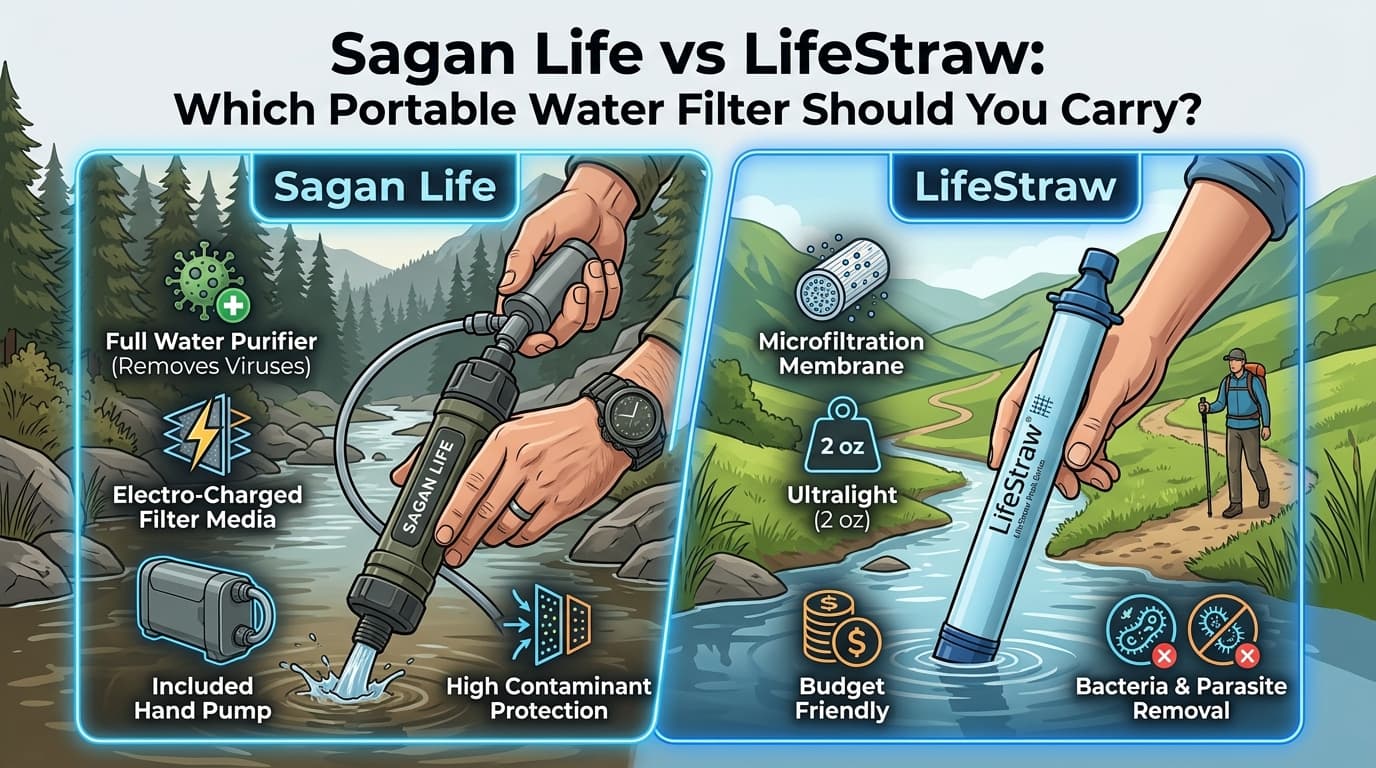
A filter physically strains contaminants out. Hollow fibre membranes with pores measured in fractions of a micron catch bacteria and protozoa — the things responsible for most waterborne illness from backcountry sources in North America and Europe.
A purifier additionally addresses viruses, which are too small for most mechanical filtration and need a chemical, electrostatic or adsorptive stage.
Which you need is geographic:
Backcountry streams and lakes in developed regions: a filter is generally considered sufficient, because viral contamination of such sources is uncommon.
Water that may contain human sewage, international travel in regions with poor sanitation, flood water, urban emergency scenarios: virus removal matters.
That is the fork in the road. Everything else is form factor.
How each brand positions itself
LifeStraw built the category. Its base products — the original LifeStraw Personal and the Go bottle — are filters, using hollow fibre membranes rated to remove bacteria and parasites. The range has since expanded to include models with additional stages for viruses and chemical reduction. Pricing on the base units is low; capacity is high.
Sagan Life positions its XStream straw as a purifier rather than a filter, and also sells the Journey filter bottle. The company has published its own direct comparison against LifeStraw, which tells you where it sees its advantage: virus claims.
Verify the specific model. Both brands sell multiple products with materially different capabilities, and a comparison at brand level is meaningless. The question is always which unit, rated for what.
How to check a claim rather than take it
This is the most useful part of this article.
Look for the specific log-reduction figures. Treatment efficacy is expressed as log reduction: 4-log is 99.99%, 6-log is 99.9999%. Reputable manufacturers publish separate figures for bacteria, protozoa and viruses. A product claiming virus removal without a stated log reduction for viruses is not making a verifiable claim.
Look for third-party testing. Standards such as NSF/ANSI protocols, or testing against the US EPA's purifier guide standard, mean an independent laboratory verified the numbers. In-house testing is not the same thing.
Check what it does not remove. Most portable units do not remove dissolved chemicals, heavy metals or salt. Some add carbon stages that reduce chlorine, taste and some chemicals. None desalinate.
Ask these of any brand, including both of these. A manufacturer that answers them clearly is giving you something to rely on.
Capacity and lifespan
LifeStraw's base units advertise high total throughput — thousands of litres over the life of the cartridge — which is the main reason the cost per litre is so low.
Sagan Life's units state their own capacities, which should be read per model.
The practical question is how you know when it is done. Mechanical filters generally slow down as they clog, which is a usable signal. Units with chemical or adsorptive stages may stop being effective without any change in flow — which means you must track usage rather than wait for a symptom. Know which kind you are carrying.
Freezing destroys hollow fibre filters. A membrane that has frozen while wet may be compromised with no visible damage. If you are carrying one in winter, it sleeps in your bag inside your jacket, not in the vehicle.
Form factor
Straws are the lightest and cheapest and require you to drink directly from the source. You cannot easily collect water, carry it or cook with it.
Bottles let you collect and carry, which is what most people actually want. Both brands make these.
Gravity and pump systems serve groups and are the right answer for several people or for filling containers at camp. Check each brand's range if that is your use case.
For hiking, a bottle is usually the sensible default. For an emergency kit that lives in a car or a cupboard, a bottle or a gravity system beats a straw, because in a real emergency you need to move water rather than lie down next to it.
Price
LifeStraw's base units are among the cheapest entry points in the category and the cost per litre is very low.
Sagan Life's units sit higher, consistent with purifier-class products generally — the additional treatment stage costs money.
If you only need filtration, paying purifier prices is spending on capability you will not use. If you need virus protection, filtration-only pricing is irrelevant because the product does not do the job.
So which?
LifeStraw if: you are hiking or backpacking in regions where bacteria and protozoa are the realistic risk, you want the lowest cost per litre, and you want the longest track record in the category.
Sagan Life if: your use case involves possible viral contamination — international travel in areas with poor sanitation, flood or emergency scenarios — and the stated purifier specification, verified against published log reductions, matches that need.
Both, arguably, if you are building an emergency kit. A cheap high-capacity filter for volume and a purifier-class unit for questionable sources is a reasonable pairing.
Before you buy
Decide filter or purifier based on where you will actually use it. Check the log-reduction figures for the specific model. Look for third-party certification. Confirm the capacity and how you will track it. Choose the form factor by use — bottle for most people. And if it will be stored for emergencies, check the shelf life of an unused cartridge.
Then check for an offer. This category discounts around outdoor-season sales. Current verified Sagan Life codes are on Discountsmaniac.
Anita Hills writes about consumer products and the practical business of buying them well. She covers home fitness, pool and garden equipment, desk hardware, automotive parts and personal care, with a focus on what a product is actually like to live with rather than what its spec sheet claims.
All articles by Anita