Anyone who has been going to reformer classes for a year has done this arithmetic. Classes cost a meaningful amount per session, several times a week, indefinitely. A machine at home is a one-time cost. At some point the machine looks obviously cheaper.
Then you look at what studios actually use, see the price, and the arithmetic stops working. Which is where the home reformer market comes in.
The short version
Balanced Body if you are teaching, running a studio, or you are an experienced practitioner who will notice a studio machine's differences every session.
Personal Hour if you are practising at home, you want the machine to fold away, and the alternative you are comparing against is a class pack you keep not using.
What actually differs
Not the concept. Both are reformers — a carriage on rails, spring resistance, footbar, straps. The movements are the same.
What differs is specification, and three things matter:
Frame length. A full studio reformer gives a longer carriage travel. For taller users and for advanced work where range of motion is the point, this is the specification that matters most. Shorter home machines limit the end of some movements for tall people.
Spring system. Studio machines use graded spring sets with fine resistance increments and very smooth loading. Home machines typically offer fewer increments. For foundational work this is fine; for progressive loading over years it is a genuine limitation.
Carriage smoothness and frame rigidity. The difference you feel immediately. A studio machine glides and does not flex. Home machines vary, and this is where quality within the home category separates.
Price
Studio reformers from established manufacturers run into the thousands, often several thousand, before accessories.
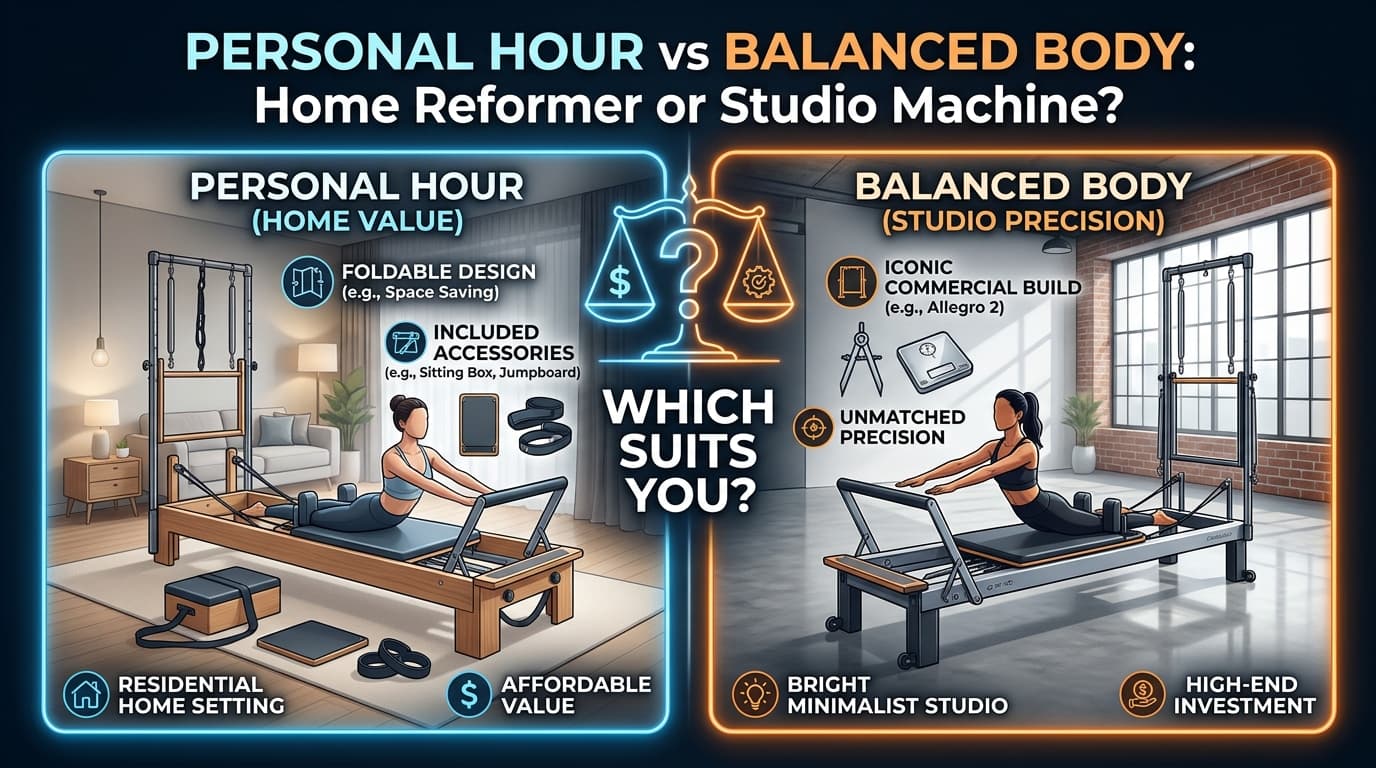
Personal Hour's foldable reformers sit far below that. The brand's positioning is explicitly around bringing reformer machines to home users at accessible prices, and its range covers foldable models alongside studio-style frames — the Janet Elite Plus and Nano Pro Studio among them.
The honest framing: you are not buying a cheaper studio machine. You are buying a different category of object that does most of the same exercises.
Folding, which is the actual product
This is the feature that decides it for most home buyers, and it deserves more attention than it usually gets.
A full reformer is roughly the footprint of a single bed and it does not move easily. In a dedicated room, fine. In a living room or a spare bedroom that is also an office, it is a problem — and a machine that lives in the way is a machine you stop using.
Foldable reformers address exactly this. The trade-offs are real: a folding mechanism is a hinge, and a hinge is a potential source of flex and of long-term wear. But a folding machine you use three times a week beats a rigid machine you stopped using because it was in the way.
Be honest about where it will live before you compare anything else.
Weight capacity and user height
Two specifications people skip and then regret.
Check the stated maximum user weight. Home machines generally state lower limits than studio equipment. Exceeding it is both a safety and a durability problem.
Check the carriage travel against your height. Taller users — roughly 5'10" and above — are the group most likely to find a shorter home reformer limiting. If you are tall, this is the specification to check first, before price.
Assembly and setup
Studio machines usually arrive assembled or with professional installation.
Home reformers ship flat-packed and you assemble them. Budget a couple of hours and ideally a second person. Follow the sequence on spring tensioning precisely — getting that wrong affects both feel and safety.
Check delivery terms too. These are heavy, and kerbside delivery means moving a substantial box yourself.
Teaching yourself, which is the real risk
This is not a brand issue but it determines whether the purchase works.
Reformer work has genuine technique requirements, and bad form on a loaded carriage can cause injury rather than just being ineffective. If you have never used one, buying a machine and learning from video is a worse plan than it sounds.
The sensible sequence: take classes until the fundamental movements are automatic, then buy a machine to practise between classes or to replace most of them. People who do it in that order get value from a home machine. People who buy first often do not use it.
Longevity
Studio machines are built for many users, many hours a day, for years, and they hold value — there is a real used market.
Home machines are built for one or two users at domestic frequency. That is an appropriate design target, not a flaw, but it means the lifespan assumptions differ and resale is weaker.
Check warranty terms on the frame, the carriage mechanism and the springs separately. Springs are consumables and will need replacing eventually — confirm they are available to buy on their own.
So which?
Balanced Body if: you are teaching or running a studio; you are tall and need full carriage travel; you are an advanced practitioner progressing through fine resistance increments; or you want an asset that holds value.
Personal Hour if: you are practising at home, space is constrained, you want it to fold away, and the realistic comparison is against studio classes you are paying for or skipping.
Classes, for now, if: you have never used a reformer. Learn the movements on someone else's machine first.
Before you buy
Measure the space both folded and unfolded, including room to move around it. Check your height against carriage travel and your weight against the stated maximum. Confirm spring availability as replacement parts. Check delivery terms and assembly requirements. And be realistic about where it will actually live.
Then check for an offer. Reformers discount periodically and the amounts are significant at these prices. Current verified Personal Hour offers are on our sister site, Discountsmaniac's Personal Hour page.
Building out a home gym as well? See Building a Home Gym in a Single-Car Garage and RitFit Home Gym Equipment: What They Make and Who It Suits.
Anita Hills writes about consumer products and the practical business of buying them well. She covers home fitness, pool and garden equipment, desk hardware, automotive parts and personal care, with a focus on what a product is actually like to live with rather than what its spec sheet claims.
All articles by Anita