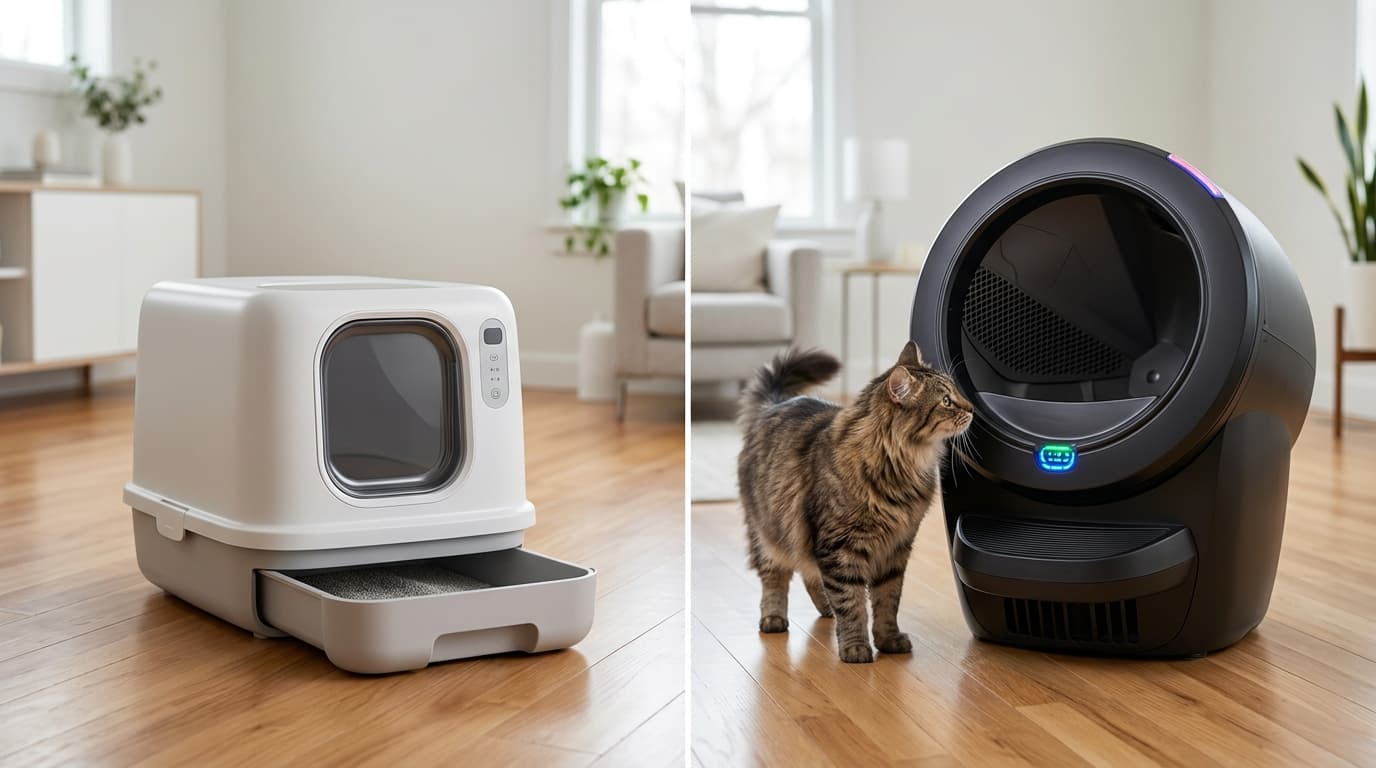
Nobody enjoys scooping a litter box. That is the entire market, and it explains why a category of machine that costs as much as a washing machine exists at all.
Litter-Robot has been the default recommendation for years. A cluster of brands now sell apparently similar machines for a fraction of the price, and Meowant is among the more visible. The question is what the gap buys.
The short version
Litter-Robot if you want the longest track record, the strongest support and resale, and you can absorb the cost.
Meowant if the premium price is the thing stopping you automating this at all, and you are willing to do slightly more maintenance.
Either way, read the safety section below before buying any machine in this category.
Price
Litter-Robot's current generation sits around the high hundreds. Meowant's units sit well below that, often in the low-to-mid hundreds, with WiFi app control included at that price.
That gap is the comparison. Everything else is a question of whether the cheaper machine does the job well enough.
Design, and how cats respond to it
This matters more than any specification, because a self-cleaning box a cat refuses to use is an expensive ornament.
Litter-Robot uses a rotating globe. The cat enters a raised, enclosed chamber, and after use the globe rotates to sift waste into a drawer below. It is large, and the entry is elevated.
Meowant offers both a round and a more conventional enclosed form, also using a rotating sifting mechanism, with WiFi and app monitoring.
Neither design suits every cat. Cats that dislike enclosed spaces, kittens, elderly cats with mobility issues, and very large cats all find automated boxes harder than an open tray. Nervous cats may be put off by the motor noise during a cycle.
Practical advice regardless of brand: keep the old box available for a few weeks. Run the new one alongside it. Cats that are forced into a change sometimes solve the problem by going somewhere else in your house, and that is a much worse outcome than scooping.
The safety question, which applies to the whole category
Any machine with a motorised chamber a cat climbs inside needs working occupancy detection. Reputable units use weight sensors, infrared, or both, and will not cycle while a cat is present, with a delay afterwards.
Ask specifically, for any model you are considering:
What sensor type detects occupancy, and is there more than one?
What is the minimum cat weight it reliably detects? Kittens and very small cats are the risk case, and many units state a minimum weight below which they are not recommended.
Does it stop mid-cycle if the cat re-enters?
Can the cycle delay be adjusted?
This is not a brand-specific concern and it is not a reason to avoid the category. It is a reason to check specifications rather than assume, and to supervise the first several uses whatever you buy.
If you have a kitten, wait. Most manufacturers state a minimum weight, and that guidance exists for a reason.
Maintenance, which is where the price gap shows
Neither machine is maintenance-free. Both need the waste drawer emptied — typically every few days to a week depending on how many cats — and both need periodic full cleaning, which means disassembly.
Where premium pricing tends to show:
Ease of disassembly and cleaning. This is the single most underrated difference. A machine that is awkward to take apart gets cleaned less often, which is how smell problems start.
Sifting accuracy. Less efficient sifting means more clumps missed and more wasted litter.
Motor durability over years of daily cycling.
Owner feedback on budget units in this category generally reports that they work, with cleaning being more of a chore than on premium machines. Weigh that against doing it by hand every day, which is what you are comparing against.
Litter compatibility
Both work with clumping clay litter, and both work best with it. Crystal, pine, paper and other alternative litters sift unpredictably in rotating mechanisms, and manufacturers generally specify clumping clay.
If you are committed to a non-clay litter for environmental or health reasons, check compatibility explicitly before buying either, and expect a compromise.
App features
Meowant's units include WiFi and app monitoring at their price point, which is genuinely a feature — usage tracking tells you how often each cat is going, and a change in that pattern is a real early warning for urinary problems.
Litter-Robot's app is more mature and its multi-cat tracking is better developed.
Be honest about whether you will use it. For many owners the app is checked for a fortnight and then ignored. For owners of an older cat with a history of urinary issues, usage tracking is the most valuable feature on the machine.
Support and longevity
Litter-Robot's advantage here is real: an established company, available parts, a known warranty process, and a used market.
For any budget brand in this category, check the warranty length, whether replacement parts are sold separately, and where service happens for your country. A machine with no parts availability is disposable, and that changes the cost calculation over five years.
So which?
Buy Litter-Robot if: you have multiple cats, you want the most refined machine and the best support, and the cost is manageable.
Buy Meowant if: the premium price is what has stopped you buying one at all; you have one or two adult cats of normal size; and you accept slightly more hands-on cleaning.
Buy neither if: you have a kitten under the manufacturer's stated minimum weight, a cat with mobility problems, or a cat with a history of litter box avoidance. Automating a box a cat already dislikes makes the problem worse.
Before you buy
Weigh your cat and check it against the minimum. Measure the space including the clearance for the drawer. Check litter compatibility. Confirm the warranty and parts availability. And plan the transition — new box alongside old box for several weeks, not a swap.
Then check for a code. Pet tech discounts regularly and the amounts are meaningful at these prices. Current verified Meowant offers are on Discountsmaniac.
Anita Hills writes about consumer products and the practical business of buying them well. She covers home fitness, pool and garden equipment, desk hardware, automotive parts and personal care, with a focus on what a product is actually like to live with rather than what its spec sheet claims.
All articles by Anita