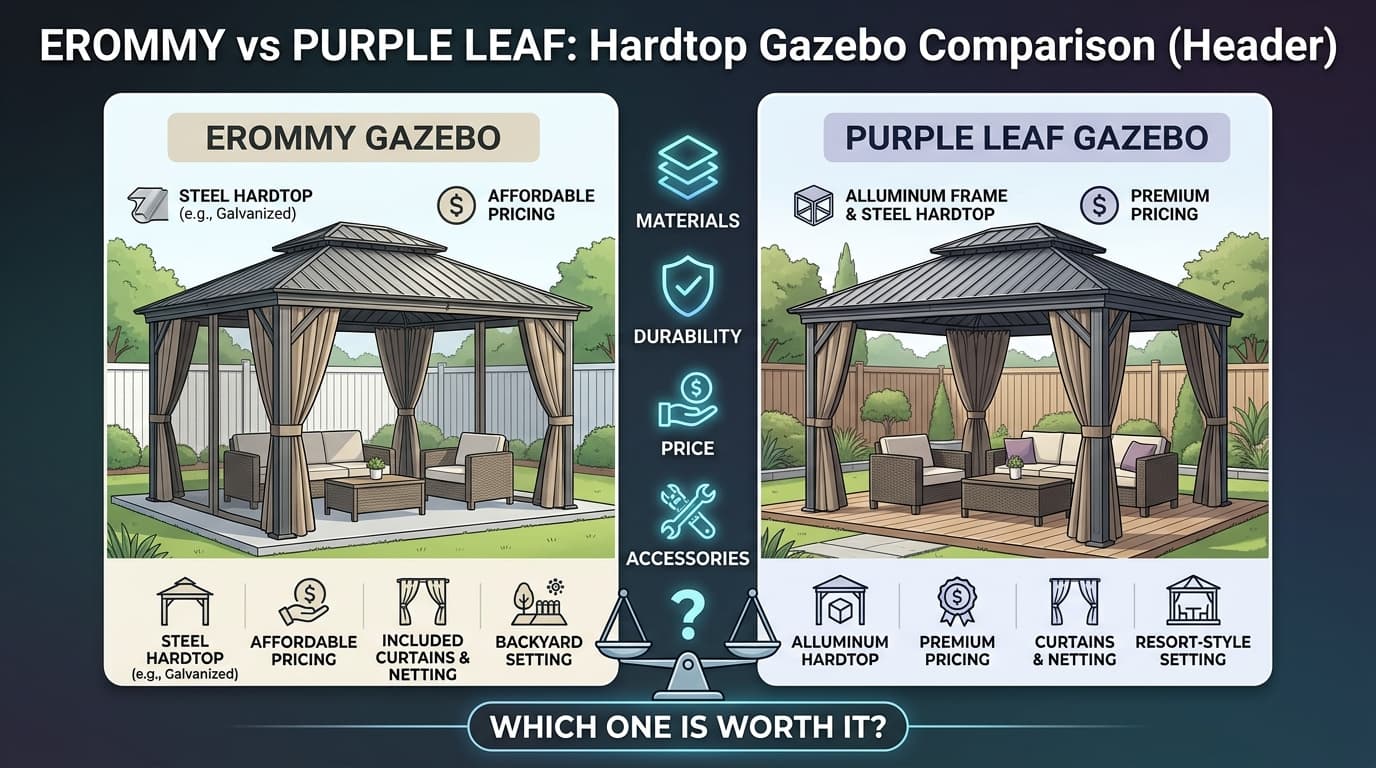
Hardtop gazebos are a category where the product photographs are almost useless for comparison. Aluminium frame, double roof, mosquito netting, curtains — every listing says the same thing, at prices that vary by hundreds.
The things that actually decide whether yours is still standing in five years are mostly not in the headline description.
The short version
Erommy for value, breadth of sizes, and availability through major retailers with real returns policies.
Purple Leaf for slightly heavier specification at the top of its range, if you are in a demanding climate.
The honest answer is that these two overlap heavily and the specific model matters far more than the brand.
Roof material, which is the first real fork
Both brands sell more than one roof type and they behave very differently.
Galvanised steel is opaque, more rigid, handles snow load better, and makes noticeably more noise in heavy rain. It casts full shade.
Polycarbonate is translucent, lets diffused light through, and is quieter. It is lighter and generally rated for less snow load. Cheap polycarbonate yellows and becomes brittle with UV exposure over years — check whether the panels carry a UV-protective coating and what the warranty says about discolouration.
Erommy sells both; its range includes galvanised steel double-roof models and polycarbonate double-roof models across sizes from compact 10x10 up to large 20x12 spans.
Decide by climate and use. Heavy snow region or you want full shade over a hot tub: steel. Mild climate and you want light through: polycarbonate, with the UV question answered.
The double roof, and what it is for
Both brands advertise double or vented roofs. This is not purely marketing — a vented upper tier lets hot air escape rather than collecting under the canopy, which makes a real difference to how usable the space is in summer. It also reduces wind uplift, which is the main way these structures fail.
If a model does not have a vent, it will be hotter underneath and more vulnerable in wind.
Wind and snow ratings — ask for the numbers
This is the specification that separates a gazebo that survives from one that does not, and it is the one most commonly absent from listings.
Ask, for the specific model:
Wind rating in mph or km/h
Snow load rating in pounds per square foot or kg/m²
Whether the rating assumes anchoring, and to what — a concrete slab rating does not apply to a deck or to grass
A brand that publishes these is telling you something. A brand that does not is also telling you something.
Then compare against your actual location. If you are somewhere with real winters, the snow figure is the number that matters, and it is worth paying more for.
Anchoring, which is not optional
Hardtop gazebos fail in wind, almost always because they were not anchored properly.
Check what anchoring hardware is included and what surface it suits. Concrete, deck and ground anchors are different fixings, and the ones in the box may not be the ones for your patio. Budget for correct anchors separately and fit them on day one, not after the first storm warning.
A gazebo that lifts does serious damage to whatever it lands on.
Assembly
Both are substantial DIY builds. Expect most of a day with two people, and genuinely do not attempt one alone — panels catch wind during assembly, which is both frustrating and dangerous.
Owner feedback across this category, including on Erommy's units through Wayfair and Walmart, consistently reports solid finished structures with assembly as the hard part and shipping damage as the recurring complaint. That is a category-wide pattern rather than one brand's problem.
Practical advice: open and inventory every box on arrival, before the installer or the help arrives. Missing or damaged parts are common, and discovering one mid-build costs you a weekend.
Buying channel matters more than usual
Both brands sell through major retailers as well as direct.
For an item this large, heavy and prone to shipping damage, buying through a channel with a genuine returns and replacement process is worth real money. Wayfair, Walmart and similar handle damaged-freight claims routinely. Direct purchase may be cheaper and may leave you negotiating over a bent panel.
This single decision affects your outcome more than the brand choice does.
Price
Erommy generally sits at the value end, with a wide range of sizes.
Purple Leaf prices slightly above for comparable sizes, with heavier specification on some models.
Compare like for like: same footprint, same roof material, same roof tier count. It is easy to compare a steel double-roof model against a polycarbonate single and conclude one brand is cheaper.
Extras worth having and not
Worth it: mosquito netting (genuinely transforms summer evening use), curtains for privacy and low sun, and integrated gutters that direct water away rather than down your neck at the entrance.
Less so: integrated lighting, which is usually low quality and easily replaced with your own.
So which?
Erommy if: you want the widest range of sizes at the value end, you are buying through a major retailer, and your climate is moderate.
Purple Leaf if: you want slightly heavier specification and you are in a snow or wind-exposed location where the ratings matter.
Neither, yet, if: you have not checked your local planning or permit rules. Permanent structures above certain sizes need permission in many areas, and anchoring to a slab can count as permanent.
Before you order
Measure the space including clearance on every side. Check the ratings against your climate. Confirm what anchoring hardware is included and buy the right ones for your surface. Verify your permit position. Buy through a retailer with a real returns policy. Arrange help for assembly. And inventory every box on delivery.
Then check for a code. Outdoor structures discount hard at the end of the season, and buying in autumn for next summer is genuinely cheaper. Current verified Erommy offers are on our sister site, Discountsmaniac's Erommy page.
Anita Hills writes about consumer products and the practical business of buying them well. She covers home fitness, pool and garden equipment, desk hardware, automotive parts and personal care, with a focus on what a product is actually like to live with rather than what its spec sheet claims.
All articles by Anita